This article may contain affiliate links. If you buy through them we may earn a commission at no extra cost to you.
A smartphone camera converts light into electrical signals on a silicon sensor, then runs those signals through algorithms on a dedicated image processor to produce a finished photo in under a second. The quality of that photo depends on physics (sensor size, aperture), optics (lens design, focal length), and software (noise reduction, multi-frame stacking)—in roughly that order of importance.
The Image Sensor: Where Light Becomes Data
The sensor is a silicon chip covered in millions of photodiodes. When photons strike a photodiode, they displace electrons, creating a charge proportional to light intensity. That charge is read out as a voltage, digitized, and passed to the processor.
Sensor Size and Pixel Count
Sensor size is expressed as a diagonal fraction of an inch—1/1.3″, 1/1.56″, 1/2.3″, and so on. A larger sensor gives each photodiode more surface area to collect light. A 1/1.3″ sensor (common in 2026–2026 flagships) gathers roughly 3× more light per pixel than a 1/2.3″ sensor found in entry-level phones, which directly reduces noise in dim conditions.
Pixel count is separate from sensor size and is frequently misunderstood. A 48 MP sensor on a small chip packs each photodiode into a smaller area, so each one captures less light individually. A 12 MP sensor on a larger chip often produces cleaner images in low light than a 48 MP sensor on a smaller one, because each pixel has more room to collect photons before the signal drowns in noise.
Bayer Filter Array
Photodiodes detect brightness, not color. To record color, manufacturers bond a Bayer filter to the sensor—a repeating mosaic of red, green, and blue filters arranged so that 50% of pixels see green, 25% red, and 25% blue (green is weighted because human vision is most sensitive to it). Each photodiode records only one color channel. The processor reconstructs the missing two channels for every pixel by sampling its neighbors, a process called demosaicing.
The Lens: Focusing and Aperture
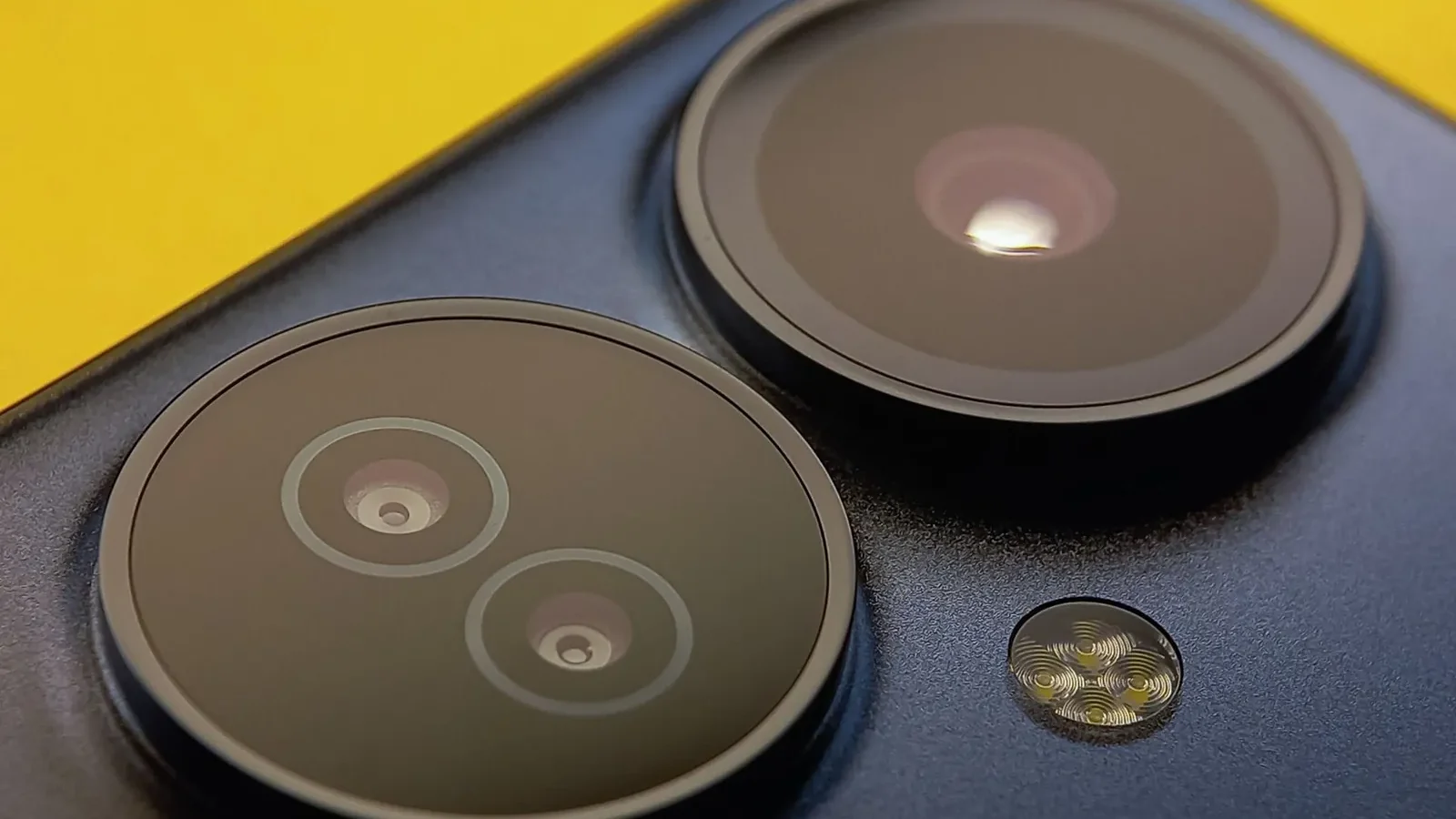
Smartphone lenses use 5–9 stacked glass or plastic elements to correct aberrations and achieve a wide field of view in a package thinner than 10 mm. Focal length—expressed as a 35 mm equivalent—determines how much of a scene fits in the frame: a 24 mm equivalent captures a wide view, while a 77 mm telephoto narrows the angle and magnifies distant subjects.
Aperture and Depth of Field
Aperture is the effective diameter of the lens opening, written as an f-number. Because aperture area scales with the square of the f-number ratio, an f/1.5 lens admits roughly 4× more light than an f/3.0 lens—a two-stop difference that can mean the difference between a sharp handheld shot and a blurry one at 1/30 s.
Aperture also governs depth of field. A wider opening (f/1.5) focuses a shallow plane and blurs the background; a narrower one (f/5.6) keeps more of the scene sharp. On phones with fixed-aperture lenses, portrait mode software simulates this blur digitally—with varying accuracy depending on scene complexity.
Autofocus Methods
Phase detection autofocus (PDAF) uses dedicated masked pixels on the sensor to measure the phase difference between two light paths, letting the processor calculate focus distance directly rather than hunting for it. This makes PDAF fast enough to track moving subjects. Contrast detection moves the lens incrementally and measures sharpness at each position—slower, but more precise for macro distances where PDAF struggles.
Image Processing: From Raw Data to Finished Photo
Raw sensor output is linear, noisy, and single-channel per pixel. The image signal processor (ISP)—a dedicated chip separate from the main CPU on most flagships—runs a fixed pipeline to turn that data into a viewable image.
Demosaicing and White Balance
After reconstructing full-color pixels from the Bayer pattern, the ISP corrects color temperature. Tungsten light is roughly 3000 K (orange cast); midday daylight is around 5500 K; overcast sky is 7000 K (blue cast). The processor measures the scene’s dominant color and scales the red, green, and blue channels to neutralize the cast—a process that fails visibly when mixed light sources are present.
Noise Reduction and Sharpening
In low light, the sensor’s signal-to-noise ratio drops because the photon count per pixel is small relative to the electronic noise floor. Noise reduction algorithms identify and smooth random variation while trying to preserve repeating textures. The trade-off is unavoidable: too aggressive, and fine detail (hair, fabric weave) smears into a watercolor effect; too conservative, and the image looks grainy. Flagship phones tune this balance per-scene using machine learning classifiers; budget phones apply a single fixed curve.
Sharpening increases contrast at edges to restore detail softened by the lens and demosaicing. Oversharpening produces bright halos along high-contrast boundaries—a common artifact on phones with aggressive processing defaults.
Computational Photography: Multi-Frame Processing
Single-frame physics limits how much light a small sensor can gather before motion blur or noise becomes unacceptable. Computational photography works around this by capturing multiple frames and combining them.
HDR
HDR captures two to four frames at different exposures—typically one stop underexposed to protect highlights, one stop overexposed to lift shadows, and one at metered exposure—then blends them pixel by pixel. The result extends dynamic range beyond what any single exposure allows. On current flagships, the full HDR pipeline takes 0.5–2 seconds; on mid-range phones with slower ISPs, it can reach 3–4 seconds, during which a second shot is unavailable.
Night Mode
Night mode captures 5–15 frames at elevated ISO while using gyroscope data to align them before stacking. Random noise is incoherent across frames and averages toward zero; real detail is coherent and reinforces. The result can produce a usable image at 1–3 lux—candlelight level—where a single-frame camera at the same ISO would show mostly noise. Exposure time per frame is typically 1/15–1/4 s, so the subject must be still during the capture sequence.
Portrait Mode and Depth Estimation
Dual-camera phones calculate depth by comparing how objects shift between two lenses spaced 10–30 mm apart—the same stereo geometry the brain uses with two eyes. Single-camera phones substitute a machine learning model trained to infer depth from edges, texture gradients, and object recognition. Both methods then apply a synthetic blur (usually a Gaussian or lens-shaped kernel) to pixels beyond the estimated focus plane. Stereo depth is more reliable on complex backgrounds; ML depth handles transparent or fine-edged subjects (hair, glasses) poorly on all current phones.
Smartphone camera quality today depends more on software than on sensor size—a 2026 mid-range phone often outperforms a 2018 flagship because of better algorithms, not better hardware.
Multiple Lenses and Focal Lengths
Each lens on a multi-camera phone has its own sensor, aperture, and ISP pipeline. The phone switches between them based on zoom level or scene type, sometimes blending output from two lenses at transition zoom levels.
| Lens type | Typical focal length (equiv.) | Common aperture | Primary use |
|---|---|---|---|
| Ultrawide | 14–16 mm | f/2.2–f/2.8 | Architecture, landscapes, tight spaces |
| Main (wide) | 24–28 mm | f/1.5–f/2.0 | General photography, low light |
| Telephoto | 77–240 mm | f/2.8–f/4.0 | Portraits, distant subjects |
| Macro | 2–5 mm equiv. | f/2.4–f/4.0 | Extreme close-ups (limited utility) |
Optical zoom physically adjusts the lens to magnify the subject with no resolution penalty. Digital zoom crops the sensor output and upscales it—a 3× digital zoom on a 12 MP sensor produces the equivalent of a 1.3 MP image enlarged, visible as softness. A 3× optical telephoto is meaningfully more useful than a 10× digital zoom on a phone with no telephoto lens.
The Role of Processor and ISP
Qualcomm’s Spectra ISP (built into Snapdragon 8 Gen 3) and Apple’s Neural Engine (A17 Pro) handle demosaicing, noise reduction, and scene classification in dedicated silicon rather than general-purpose CPU cores. This matters because it determines how quickly night mode stacking and HDR blending complete—and whether the phone can sustain 4K 60 fps video without thermal throttling. More RAM (8–12 GB on current flagships) allows the ISP to hold more frames in memory simultaneously during multi-frame processing.
Practical Impact: How Specs Translate to Photos
When comparing phones, weight these factors in order:
- Sensor size and main lens aperture: These set the ceiling for light-gathering. An f/1.5–f/2.0 aperture on a 1/1.3″ sensor is strong; f/2.8 on a 1/2.3″ sensor is a significant step down in low light.
- Night mode and HDR quality: Software-dependent and not predictable from specs alone—test with sample shots in dim, high-contrast scenes.
- Processor generation: A 2026-or-later ISP processes faster and applies more accurate noise models than a 2020-era chip, even with identical sensors.
- Megapixels: 12–48 MP covers every practical output size, including 16×20″ prints. Above 48 MP, gains are only relevant if you crop heavily.
- Zoom range: Optical zoom up to 3–5× is genuinely useful. Beyond that, evaluate whether the phone has a dedicated telephoto lens or is relying on digital zoom.
For phones that balance these factors at lower prices, see our guide to the best smartphone cameras under $300, and the broader best budget Android phones under $300 roundup.
Frequently asked questions
Why do smartphone cameras perform worse in low light than human eyes?
Human pupils dilate to roughly f/0.77 in darkness—wider than any smartphone lens. The retina is also about 24 mm in diameter, far larger than any phone sensor, and your visual system integrates light over 100+ milliseconds. Smartphone sensors use exposures of 1/30 s or faster to avoid motion blur, limiting light collection. Night mode partially compensates by stacking multiple frames, but can’t match the eye in near-total darkness.
What’s the difference between optical and digital zoom?
Optical zoom moves lens elements to magnify the subject on the sensor, preserving resolution. Digital zoom crops the captured image and enlarges the crop, discarding pixels. A 3× digital zoom on a 12 MP sensor produces the equivalent detail of a 1.3 MP image—visible as softness at normal viewing sizes.
Does a higher megapixel count always mean better photos?
No. Megapixels determine maximum print size and crop flexibility, not image quality. A 12 MP sensor with a large photodiode area and wide aperture captures more light per pixel than a 48 MP sensor on a smaller chip—and more light per pixel means lower noise. For social media, screen viewing, and prints up to 8×10″, 12 MP is sufficient.
How does portrait mode create background blur without a second camera?
A machine learning model estimates per-pixel depth from edge sharpness, texture gradients, and object recognition (it identifies that a face is likely in the foreground). The processor then applies a synthetic blur kernel to pixels classified as background. This works reliably for people against simple backgrounds but fails on fine edges like hair, transparent objects, and scenes where the subject and background share similar textures.
Why does my phone’s camera perform worse in video than in photos?
Video requires the ISP to process every frame in real time—at 30 fps, that’s 33 milliseconds per frame, with no time for multi-frame stacking. Night mode and HDR are unavailable on most phones during video recording because both require capturing and blending multiple exposures. Video codecs also apply lossy compression that reduces fine detail, and sustained 4K recording can cause thermal throttling on phones with weaker cooling, degrading quality further over time.

Lena writes about smart home, audio and the software settings nobody reads the manual for.